Successful Losers Keep the Weight Off
At any given time, nearly 60 percent of Americans are actively trying to lose weight. It is no surprise that a myriad of weight loss products, diet books and gadgets flood the marketplace. Although many people succeed at losing weight, few manage to keep the weight off for the long haul. Those who have are referred to as “successful losers” and research studies on these individuals reveal the keys to permanent weight loss.
The National Weight Control Registry (NWCR) is the largest ongoing study on long-term weight loss. To be included in the study, you must have lost at least 30 pounds and kept the weight off for at least one year. On average, the 5,000 participants have lost 60 pounds and maintained the weight loss for nearly six years. The range of weight loss is 30 to 300 pounds, which means any weight loss goal is possible. Interestingly, the odds appear stacked against these individuals as nearly half were overweight or obese as kids and three-quarters have at least one obese parent. So, if you think you’re doomed because of your genetics, here is clear evidence to the contrary. You are NOT destined to be overweight for life and you CAN overcome it by changing certain behaviors. Here are the habits successful losers adopted to drop those unwanted pounds:
- Eat breakfast daily
- Exercise approximately 60 minutes a day
- Check weight at least once a week
- Watch less than 10 hours of television per week
- Maintain a consistent diet on weekends and weekdays
- Track food intake
Eating breakfast every day helps manage hunger and may prevent over-eating and poor food choices later in the day. When we get extremely hungry, the tendency is to select foods we wouldn’t normally eat. Daily exercise boosts your calorie burn which helps balance out the calories you take in. Remember, the definition of a stable weight is when the calories you consume equals the calories you expend. This doesn’t mean you have to do exercise you don’t enjoy. Most successful losers walk as their primary exercise. Checking your weight regularly helps you stay in tune with your body and allows you to adjust your intake or activity if your weight creeps up. In fact, 44 percent of successful losers weigh themselves every day, and most check at least once a week. Limiting TV time has a twofold effect – you’re less likely to snack mindlessly and you’re probably up burning more calories than you would be sitting in front of the tube. Eating consistently each day of the week, including weekends, helps prevent you from eating more than you need, which over time leads to weight gain. Participants who had a consistent diet were one and a half times time more likely to maintain their weight within five pounds compared to those who didn’t.2 This is probably because a weekend of over-indulging can wipe out an entire week of progress. Finally, tracking what you eat keeps you aware of what and how much you eat. This is especially important in weight control since most of us underestimate by at least 20-30 percent. (Read "How You May be Sabotaging Your Weight" for a detailed discussion).
Other research has confirmed the findings of the NWCR and identified additional behaviors of sustained weight loss:
- Plan meals on most days of the week
- Track fat and calories
- Measure food
- Add physical activity into daily routine
- Set goals
It’s important to note that all of these behaviors are not required to achieve success, but they are habits that have been shown to be effective. It is certainly possible to reach and maintain your goal by simply eating less, moving more and adjusting based on whether the scale goes up or down.
Another essential component of long-term weight loss is social support.5, Whether it’s a friend, coach, health professional or online community, it’s important to have someone who will listen and give feedback. Online weight control programs have become popular because of convenience and the community support they offer. However, the most effective online programs provide structure, ongoing personalized feedback and support.
Why do most people gain the weight back?
In a nutshell, people return to their original weight (and more) when they stop doing what made them successful in the first place. Participants of the NWCR who regained more than five pounds reported exercising less, eating more fatty foods and allowing themselves to overeat more frequently. It makes perfect sense why the majority of those who go on “fad” diets and other programs lose weight quickly and eventually gain it back. They simply cannot maintain the drastic changes most fad diets require. It’s not that fad diets don’t work; the problem is they only work on a short term basis. Keeping the weight off is the real challenge.
Do what works for YOU
Weight loss can be achieved in many different ways as long as you consistently burn more calories than you consume. (See "Weight Control 101") However, to achieve and sustain results, follow the example of successful losers who selected behaviors they could maintain for life. Keep in mind that you can start by making small changes such as taking 10 minute walks, skipping your afternoon soda or increasing your daily steps. You may not drop the pounds as fast as you’d like, but when it comes to weight loss– it’s not how you start that counts, it’s how you finish. Do what works for you for the long haul and YOU will ultimately become a successful loser.
Weight Control Basics
 You may recall from Weight Control 101 that your weight is determined by the calories you take in and the calories you burn on a daily basis. If you’re like most adults, you’ve been taking in more calories than you burn and you have excess body fat that you’d like to get rid of. If you’re not like most adults, consider yourself warned as experts predict that 9 out of 10 people will become overweight or obese at some point in their lifetime. This underscores the importance of consistently balancing the calories you take in with the right amount of activity, especially since the majority of people pack on the pounds slowly and steadily without really noticing it. Years of misjudging your intake by just a few calories at a time will end up sabotaging your weight. For example, if you gain the average amount of one pound per year, this means you’re off by only 10 calories a day. After 20 to 30 years, you’ll end up 20 to 30 pounds overweight. To help you avoid this, here are common ways people underestimate the calories they take in and unknowingly eat more than they realize.
What you don’t know WILL hurt you
Research shows that most people: 1) don’t know how much to eat to control their weight; 2) don’t accurately judge the calories they take in and 3) have no idea they take in extra calories in different situations.
In a recent national survey, only 15 percent accurately estimated how many calories they should eat to maintain their weight. Ask yourself – how many calories should I eat to maintain my weight? This begs the question – is it possible to maintain a healthy weight without knowing how many calories to eat? Certainly, if you keep regular tabs on your waistline and make the needed adjustments to your diet or activity level. Studies on college freshmen showed that daily weighing helped maintain body weight whereas those who did not weigh daily gained nearly seven pounds in ten weeks. Since most people don’t weigh themselves daily or even monthly, they don’t notice the weight creeping on. And as you can see, what you don’t know WILL hurt you.
You eat more than you think you do
Let’s say you do know how many calories to eat to manage your weight. The next question is - do you accurately judge how much food you eat? Not according to research. When people are asked to record how much they consume, they consistently underestimate. , , Overweight and obese women tend to underestimate more than other people, and it worsens as body mass index (BMI) goes up. , That is, the higher the BMI, the fewer calories people report eating. Meal size also affects how accurate we are. The larger the meal, the more we misjudge how much we eat. One study demonstrated that participants underestimated a large meal by up to 1,000 calories. If you ate an extra 1,000 calories once a week without making up for it with more activity, you’d gain almost 15 pounds in a year. An extra 1,000 calories equates to eating one more slice of meat lover’s pizza and one more fruit smoothie. The bottom line is we eat more than we think we do, making weight control quite challenging.
You eat more and don’t even realize it
Studies have also shown that people unknowingly consume more calories in the following situations:
• Food is presented in large quantities (restaurants, parties)
• A wide variety of food is present (buffets, all you can eat)
• More people are present
• Being distracted and doing something else (watching TV)
• Eating out of large packages (bag of chips, tub of ice cream)
• Tempting foods are within reach and within eyesight
• Frequently dining out
By becoming aware of how you eat in these situations, you’ll be better equipped to control the amount of food you take in.
Get informed and take charge
One of the most effective ways to get informed about the way you eat is to track it regularly. People who do lose more weight. To avoid calorie amnesia, jot down everything you consume right away. Start to pay attention to the calorie content of the items you choose by reading food labels and looking up the calorie content of restaurant foods and beverages. Keep in mind that many beverages contain calories so be sure to count those tea drinks, sports drinks and alcohol. They add up quickly especially if you’re thirsty. In certain states it is now required by law to post the calorie content directly on the menu board. You’ll think twice once you realize your favorite coffee drink and muffin has 1,000 calories. If you’re really motivated, weigh and measure the amount of food you eat with a food scale, measuring cups and measuring spoons and calculate the calories you take in. This pocket size Calorie, Fat and Carb Counter contains thousands of common foods, restaurant items and useful information. Since humans are creatures of habit, you’ll get familiar with the items you eat regularly and measuring will no longer be necessary. The idea is to get educated on how much you eat.
To prevent unconsciously eating excess calories, follow these tips:
- Eat and only eat. Avoid being distracted during mealtimes or snack times.
- Eat from smaller plates, bowls and glasses.
- Portion out your food and avoid “family style” eating or eating out of the package.
- When you dine out, control the portion sizes by sharing meals or packaging some to take home right away.
- During social occasions, decide on what you’re going to eat and stick to it. Otherwise you’ll graze mindlessly.
- Limit your alcohol intake. Alcohol tends to stimulate appetite and reduce your awareness of what you’re eating and how much.
- Keep snacks, treats and tempting foods out of reach.
- The old adage “knowledge is power” is true for weight control if you use it to make informed decisions.
It’s not rocket science if you judge by RESULTS over time
It’s challenging to manage something you aren’t aware of and don’t keep track of. Since only one third of the population acknowledges that calories are responsible for weight gain, it’s no wonder there’s an obesity epidemic. 21 (And by the way, it’s no coincidence that one third of adults have a healthy body weight.) Knowing how much you consume is a key part of successful weight control, but even if you don’t know – the scale will tell you. If the number on your scale increases over time, you’re taking in more calories than you’re burning – PERIOD. The solution is to burn off that extra fuel by moving more and eating fewer calories. If you don’t measure your results by checking your weight regularly, you’ll end up sabotaging your waistline and likely your health.
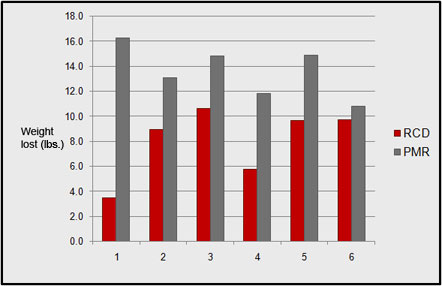
 It’s possible. Depending on what you categorize as supplements, they can be the difference between success and failure for many people. Just look at the success statistics of people using meal replacement bars and shakes to assist in weight loss compared to non-users, especially in long-term weight control (see Figure 1).
Before we start down this road of dietary supplements and weight loss, let’s remember that supplements alone are NOT a weight loss program, whereas diet and exercise alone can be. But properly used and formulated supplements can accelerate progress and make the chore easier, giving users a greater chance of sticking with their chosen method of weight loss. And on that note, let’s look at dotFIT’s position on dietary supplements and weight loss.
dotFIT Worldwide’s position on the use of dietary supplements for assisting weight control.
The goal of incorporating a dietary supplement (or drug) into a weight loss program is to assist the user in complying with the daily routine that leads to weight reduction. The supplement ingredients must have safely demonstrated the potential to act in one or more of the following ways:
- Help create and maintain a calorie deficit by increasing daily calorie expenditure when compared to a non-supplemented state
- Raise energy levels that may make one more active throughout the day
- Reduce the drive to consume food
- Decrease calorie absorption
The user would cease supplementation once the weight goal is reached or when they have their daily routines under control to continue making progress without the supplements. Dietary supplements are appropriate for 1) people with aggressive goals such a time limit (e.g. special events on set dates, making a certain weight class for sport or competition, etc.); 2) athletes preparing for competition that may require/demand very low body fat; 3) people who have failed multiple times at reaching or maintaining weight goals.
Translation: weight loss supplements are intended to help you comply with whatever course you chose to pursue weight loss while living your busy, normal life – i.e. create an easier path to your goal. And they can actually do this by
- Helping your body create and maintain a calorie deficit by burning more calories without having to add more activity, and giving you an energy boost so you’re more active throughout the day;
- Curbing appetite;
- Helping you feel full sooner;
- Decreasing the calories you absorb so you get the satisfaction of eating without all the calories.
- All in all making it easier to stick to a reduced calorie diet or exercise plan.
What we know works
Supplements that mimic the actions of successful drugs used for weight loss and meal replacements bars and shakes are the only supplements that actually work.
Drugs and weight loss
All studies show that drug therapy combined with calorie restriction is more effective in both losing weight and maintaining loss when compared to conventional methods. Successful drugs are designed to block calorie absorption and speed metabolism: e.g. Orlistat (Alli), Sibutramine & Phentermine.
The proof
In 19 studies, participants using weight loss drugs that prevent dietary fat calorie absorption and speed metabolism, combined with a dietary/lifestyle regimen, significantly increased total weight loss when compared to subjects using the dietary/lifestyle regimen and placebo. The treatment groups on average had a three-times greater chance of losing more than 5% of their total body weight and a four-times greater chance of maintaining the weight loss after two years. The problem with drug therapy is that prescription weight loss drugs should not be used for extended periods of time because they bring along known side effects. Therefore, the goal is to deliver safe, natural alternatives using dietary supplements that have the similar mechanisms of action but without the side effects.
Validated safe and effective alternatives
The following products contain the ingredients that have been shown in human clinical trials to significantly accelerate body fat/weight loss when compared to placebo users following the same routines (see below for summary of results).
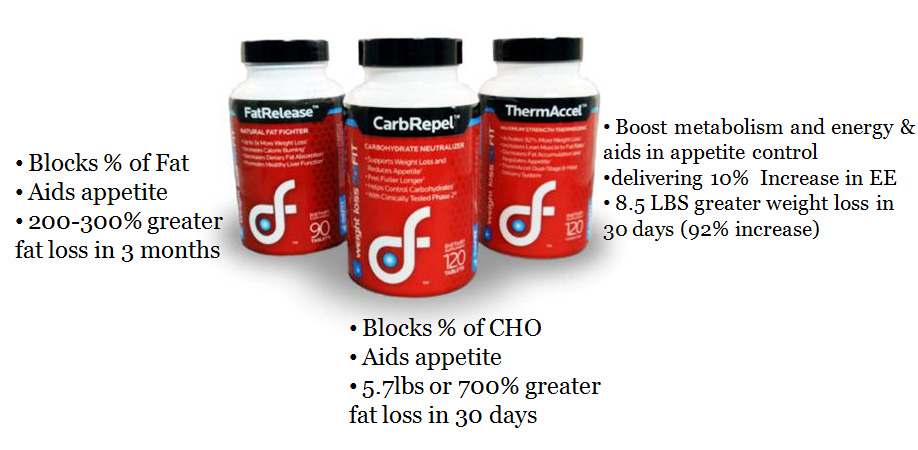
Fat Release (reduces fat calorie absorption and appetite): adds support for the body’s most active fat burning organ, your liver; helps block dietary fat from entering the body and induces fullness faster and longer (click here for all the science)
CarbRepel (reduces carbohydrate calorie absorption and appetite): helps block carbohydrates/sugars from entering the body and being stored while also working to keep food in the stomach longer in order to deliver an early and longer feeling of fullness (click here for all the science)
ThermAccel (increases calorie burn while reducing appetite): a natural stimulant to help increase your metabolism and induce you to move more by increasing energy levels while sending energy signals to your appetite center to help reduce intake (click here for all the science)
Meal replacements and weight loss
In all studies, meal replacements bars and shakes have been shown to be an extremely effective aid to weight reduction and, in almost all cases, more effective than conventional methods of dietary restrictions. Additionally meal replacements have been shown to be just as effective as dietary restriction combined with drug therapy.i Most importantly, continuous use of meal replacements may be the most effective means of all treatments when it comes to maintaining weight loss (see figure 2 below).
Meal replacements are generally used to replace one or two meals a day and allow freedom of choice for the remaining allotted foods/calories.
Meal replacements allow:
- Between meal snack as an energy boost or hunger killer
- Portion control: people generally attempt to consume meals to completion, therefore meal portion size significantly impacts a person’s total calorie intake. Overwhelming evidence validates that the smaller the portions, the fewer daily calories consumed and vice-versa – i.e. people tend to “eat with their eyes not their stomachs”. Use of portion-controlled meals has proven to yield greater weight loss than conventional diet therapy alone.
- Accurate calorie counts of total daily food intake when compared to having to estimate the calories of self-prepared or unmarked meals
Figure 1: In all six studies the groups using meal replacements (PMR) as part of their overall calorie intake lost significantly more weight than subjects using the reduced calorie diet (RCD) alone. Heymsfield SB (2003)
Figure 2: In a 1-year follow-up in the groups that were tracked, the subjects still using meal replacements maintained significantly more weight loss than the RCD group. Heymsfield SB (2003)
What happens when you stop using supplements
Meal replacements: properly formulated meal replacements or meal supplements (as they may be called) are food, just in more convenient forms for specific times. You will always eat traditional foods daily but in today’s hectic world, meal replacements should remain part of everyone’s caloric intake to help satisfy hunger between meals and/or replace at least one large meal daily. This allows freedom of choice for other meals such as lunch and dinners.
Dietary supplements: once a user reaches the weight or body composition goal, there is no longer a need for a caloric deficit. The dieter can now increase their caloric/food intake to a maintenance level, which would relieve the need for supplementation.
Summary
So there you have it, effective supplements can make the difference especially when it only takes a little help to make things easier. Use meal replacements regularly to curb hunger, allow greater choices for traditional meals and save on your grocery bill. Use dietary supplements to ease the chore and stay motivated by accelerating weight loss and assisting in appetite control.
Simply use our dotFIT program to find out exactly how to use effective supplements within your daily routine and you are on your way to long-term success. And for those of you using the exerspy, well, that makes it too easy because with the exerspy, you can cheat to win
 Visibility allows flexibility – do it your wayTo reiterate, nowhere in Part 1 did we tell you what to eat or do to lose weight. All we have said is “know how many calories you burn, what you want to weigh and when, and then you’ll know how many calories you get to eat.” And by now you know that the more you move, the more you can eat.
When it comes to accomplishing a weight or body fat goal, all that matters is that you start. What you eat and how you burn calories is no one’s concern but yours. So, on average, just burn more than you eat until you reach your goal. It’s not a program – it’s your life combined with the right tool to tell you all you need to know. That tool is the exerspy.
Here’s what one new user who’s struggled with thyroid disease and weight gain has to say about exerspy:
“I’ve used countless food logs, work out logs, and am an avid health freak. I didn’t really like online programs I used and the fact that I needed to use multiple programs (one for calorie/nutrition facts, spreadsheets, work out logs, etc.) made it an arduous task.
“I started using the exerspy on Tuesday of this week and it has been such a blessing! I LOVE IT! You have done an extraordinary job on the equipment, online program, food log, tracking mechanisms, etc. I couldn’t be happier. I wear it all the time and am thrilled about the prospect of what it can do to help me reach my goal/target weight and fitness level.”
What’s her motivation? It’s simple -- she’s able to easily fit the program to her lifestyle.
Side note: Every adult knows the difference between good and not so good food – and of course your calories should be made up of better foods – but hey, you figure that one out because at the end of the day, only the difference between your burn and your consumption determines your weight loss – NOTHING else.
The same formula applies to all of us, including those who eat well and exercise religiously but still have that pesky little spot of body fat that just won’t go away. The answer is the same. Repeat after me, “Eat fewer calories on average than you burn (do it your way) until it goes away”. And always bear in mind, you CAN’T chose to lose fat in from a specific place on your body, like your thighs or stomach.
The Undeniable Facts of Weight Control:
- Individual total calorie intake is determined by personal activity, body statistics and goal including desired time frame. The foods that make up your allowed calories can be structured to improve health & performance.
- One single fact determines the rate of weight/fat loss: the average daily calorie deficit. This is defined as the difference between how many calories you burn and how many calories you consume. Weight loss should proceed at a pace that does not compromise health or performance.
- Exercise is intended to improve your body structure, function/performance, longevity, visual appearance, etc. Exercise also increases daily calorie burn and helps you maintain your desired weight.
You must be the creator of your program or you won’t be the master
The only way you will own a behavioral change is if you create it. Start anyway you can, sticking to this simple rule: burn more calories than you consume, on average, until you reach your goal. Just follow the number.
The good news is that “one good turn deserves another”, meaning, as your body changes and you start to look better, you will also do things better. BUT the first turn has to come easily and on your terms, or you’ll take a second step to failure. Square pegs don’t fit in round holes – you need to own your program because it fits the life you choose, not a life someone else chooses for you. You want to be lean but you need to get there your way. Want maximum visibility and complete flexibility? Welcome to dotFIT Me.
Ready for more? Join us for any of our free webinars and you’ll not only learn valuable information about weight control but you might also win an exerspy. Just go to www.dotFIT.com/webinars to register for the next session.
 If you know what to do, then why CAN’T you control your weight?The simple answer to the question is motivation, because everyone knows how to lower their weight – everyone. Yes, ALL adults know (albeit many are in denial) that their undesirable or oversized fat stores are a result of eating or drinking more than they need. Therefore, everyone knows the one and only answer is to eat less, move more or a combination of the two – hello!
I travel and lecture all over the world and I have yet to meet an adult who truly doesn’t know that they’re overweight because they eat or drink too much. Nor have I met a person who wants to become overweight. So why is the majority of the adult population overweight? The first part of the answer is that people can’t see or feel daily weight changes. The average adult gains 1-3LBS per year, or in daily numbers, ~1/365 -1/182LBS per day (or an average of 10 to 30 calories per day more than you burn). This leads to the second part. Body fat creeps up so slowly it’s easy to ignore it until you’re forced to put energy into losing weight – and the perceived effort, which is any weight loss program or method, requires motivation. Motivation to change your lifestyle means motivation to change your behavior, and it requires lots of thinking, planning, actions and sometimes counseling. And the method you choose may not fit your lifestyle, which means you ultimately achieve weight regain. Yet, as previously mentioned, you DO know why you are overweight.
How do we lower the need for motivation?
Let’s go back to where we started. You are overweight because you ate more than you moved, meaning more than necessary. You also know that now you need to eat less and/or move more to fix it. Okay, nowhere in this conversation did anyone tell you what to eat or how to move, right? So what’s the simple answer to reversing the problem WITHOUT life-changing or threatening motivation?
You CAN eat ANYTHING you want – you just CAN’T eat EVERYTHING you want
Meaning, do what you do but just a little less and/or a little more. Reverse the behaviors that got you here. That’s right, no lifestyle change is required, just a minor adjustment. The rest will take care of itself. As soon as you make a big deal out of losing weight, you take your first step toward failure.
To succeed you only have to pay attention to a number, but you need to know what that number is.
You WON’T manage what you CAN’T see and you CAN’T manage what you DON’T know
To successfully achieve your goal weight YOUR way, you need to know how many calories you use every day so you know how many you can eat to lose weight or not get fat. Now you have something to manage that’s controllable daily: simple numbers. And remember, numbers don’t lie.
Motivation will come from seeing body fat coming or going in real time at any time -- hourly, daily, weekly, etc. When you can SEE your daily body fat gains and losses, it’s simple to manage them because it doesn’t take much effort to eat one less bite or take 10 extra steps to stay on track. The “icing on the cake” is that you will actually be motivated by having visibility into real time changes in your body fat. When you use a flexible program like dotFIT Me, you can view hourly and daily changes in weight and body fat as opposed to waiting until they are confirmed by the scale or change in clothing size. Flexibility is critical to your success. We’ll explain why and how in Part 2
 One factor determines your weight …calories.
Controlling your weight comes down to one thing - managing calories. Your body is a complex machine that requires fuel to run your metabolism and perform all movement. Calories from the food and beverages you consume provide this fuel. If you burn all the fuel you take in, your weight will remain stable. If you end up with excess fuel that isn’t burned, it will be stored as body fat and your weight will increase. Similarly, if you burn more fuel than you take in, you’ll lose weight – it’s that simple. By managing the calories you take in and the calories you burn, you can successfully control your weight.
So why have the majority of adults become overweight or obese in recent decades? Taking in more fuel than the body burns mostly as a result of lifestyle changes. Manual labor is now performed by machines and computers. Very few calories are burned during our daily routine because work, transportation, recreation and entertainment are mostly sedentary. People eat out more frequently and enticing food is offered everywhere in large quantities, day or night. Because humans have a natural tendency to preserve energy and eat even when we’re not hungry, modern lifestyle easily leads to unburned fuel and unwanted weight gain.
Beware of the creeping waistline
Experts predict nine out of ten people will be overweight or obese at some point in their lifetime. However, most people don’t realize they’re becoming overweight because it happens fairly slowly. The average yearly weight gain among adults is one to three pounds. This means most people are off by only 20 to 30 calories a day. Small changes such as skipping those last few bites or taking 200-300 extra steps per day will keep you trim and away from weight loss diets. But keep in mind as you get older, you’re likely to burn fewer calories because your daily routine changes. Because of this, you’ll have to become aware of the calories you take in and how much (or how little) you move. And to keep your weight in check, you’ll need to get on the scale or measure your waistline more than once a year.
Boost your calorie IQ
One of the most effective weight control tools is tracking what you eat. An old fashioned pen and paper work just fine but online trackers also offer support and feedback. After a week or so, you’ll be amazed at how much you learn and your calorie IQ will get a huge boost. Those who consistently track what they eat lose more weight and are more successful at keeping the weight off. Doing so will help you decide where to cut back – skip a regular 20 ounce soda and save 250 calories, switch from whole milk to skim milk and save 50 calories a cup, go for regular coffee instead of a regular blended drink and save 300 calories. If you’d rather reduce the portions of the foods you currently eat, that is a good option. Remember, small changes tend to be the most effective because they withstand the test of time.
Check your surroundings
Scientific studies reveal that your surroundings influence the amount we eat. The bigger the portions, the more you’ll eat. If you see or smell tempting foods, you’re likely to eat them. If you’re in a social setting, at a buffet or drinking alcohol, you’ll probably eat more. If you watch TV while you eat, you’ll overeat. So control your environment by limiting portion sizes, keeping tempting foods out of sight (and out of mind) and game planning before social events. For instance, you may decide to eat or exercise before the party. In any case, be conscious of your environment otherwise you’ll take in more calories without even noticing it.
Step up your activity level
Every calorie you consume or have stored on your body can be burned through activity. If weight control is the goal, step up your activity level. Start by determining how active you are by using a pedometer to measure the steps you take. Gradually increase your daily steps any way you can – short walks, more chores, pacing while watching TV or talking on the phone and of course, climbing stairs at every opportunity. If you prefer the gym, that’s fine too as long as you’re burning more calories by working harder or adding to your regular workouts. Keep in mind that the more active you are, the more fuel your body burns. This means you can speed up your weight loss efforts or choose to eat more. For current physical activity guidelines, click here.
Monitor your progress and adjust
Monitor your progress at least once a week by weighing in or taking your circumference measurements. For accuracy purposes, it’s best to check your weight at the same time of day with the same clothing. Also, consider weighing in mid week because weight fluctuations tend to occur after a weekend of dining out or indulging. Because weight can fluctuate on any given day, judge your progress over time. If your results aren’t moving in the right direction after any two to three week period, you’ll need to adjust. Reduce the calories you take in or increase movement until you make progress.
Set goals and get support
Set a short term and long term goal and write them down. In doing so, you make a commitment to yourself which helps propel you into immediate action. Healthy weight loss for most people is half a pound to two pounds per week but the more weight you have to lose, the faster you can lose it. One pound of body fat contains approximately 3,500 calories. Use the table below to determine how many extra calories you’ll have to burn or cut out of your diet each day for different weight loss goals.

 Food Logging – A Powerful Weight Loss Tool
You may surprised by the fact that losing weight is not the main challenge for most people. Keeping it off is much more of a struggle. In fact, only a small percentage of those who lose at least 10 percent of their initial body weight manage to sustain their results. The remaining majority regain all of the weight lost within three to five years. This is likely due to the way many individuals go about losing weight – short-term, or fad diets. The issue with diets is that they tend to be a temporary fix and the eating rules are difficult to sustain. Although you lose weight initially, once you resume your old habits, the weight comes back and often more. It is simply unnatural to cut out whole food groups and drastically cut calories - our bodies will fight it. For you to lose weight and keep it off for good, you’ll have to adjust your food choices and activity level permanently. That means the changes you make should be something you can see yourself doing for the rest of your life. And they don’t have to be earth shattering. Perhaps you switch regular soda for diet and save 200 calories a day. And maybe you add a 15 minute walk twice a day and burn 200 more calories, but the bottom line is they’re doable for life. Remember, the only proven method to lose weight is to burn more calories than you take in, and research shows that different eating patterns, whether high-carb, low-carb, low-fat or high-fat, can all yield results as long as you burn more than you take in. Only you can determine what works best for you.
So how do you change or adjust your eating and activity habits? You must first be fully aware of your body’s needs and what you’re doing now – and you probably aren’t. Studies show that most people:
- Don’t know how much to eat to maintain their current weight
- Believe they eat less than they actually do
- Have no idea they take in extra calories in different situations
- Slowly gain 1-3 pounds a year during adulthood until they are overweight or obese
The solution to becoming aware of your food choices and how much you’re eating is to simply pay attention by tracking everything you consume. When you track what you eat, you can’t help but notice the types of foods you’re eating, the calories in those items, and how your choices affect your weight, appetite and energy levels. Your dotFIT online program shows you the number of calories you should eat daily to reach your goal, and by tracking your calories it becomes clear when you need to make an adjustment. Without knowing what and how much you’re eating – it’s difficult to make educated decisions. For example, if your daily calorie budget is 1,600 and you eat 1,000 for breakfast, you know you have 600 left for the rest of the day. At this point it’s clear that you’re probably eating too many calories at breakfast and it’s wise to adjust your food choices. You can adjust the portion size of that meal or the choose different foods that have fewer calories and hopefully more nutrients. Again, it’s your decision.
If you still need a reason to track your calories, here it is – you’ll get twice the results. A large study spanning almost 3 years showed that people who kept tabs of their daily food intake lost twice as much weight as those who didn’t. In this day and age where food is everywhere any time of day and in very large quantities, you can’t afford to be unconscious of your choices. By paying attention to portion sizes, calories and nutrients in foods, you become equipped with new knowledge and therefore, new power to reach and maintain your goals. It is true that knowledge is power, but only if you use that knowledge by taking action. Take action and start logging your food today.